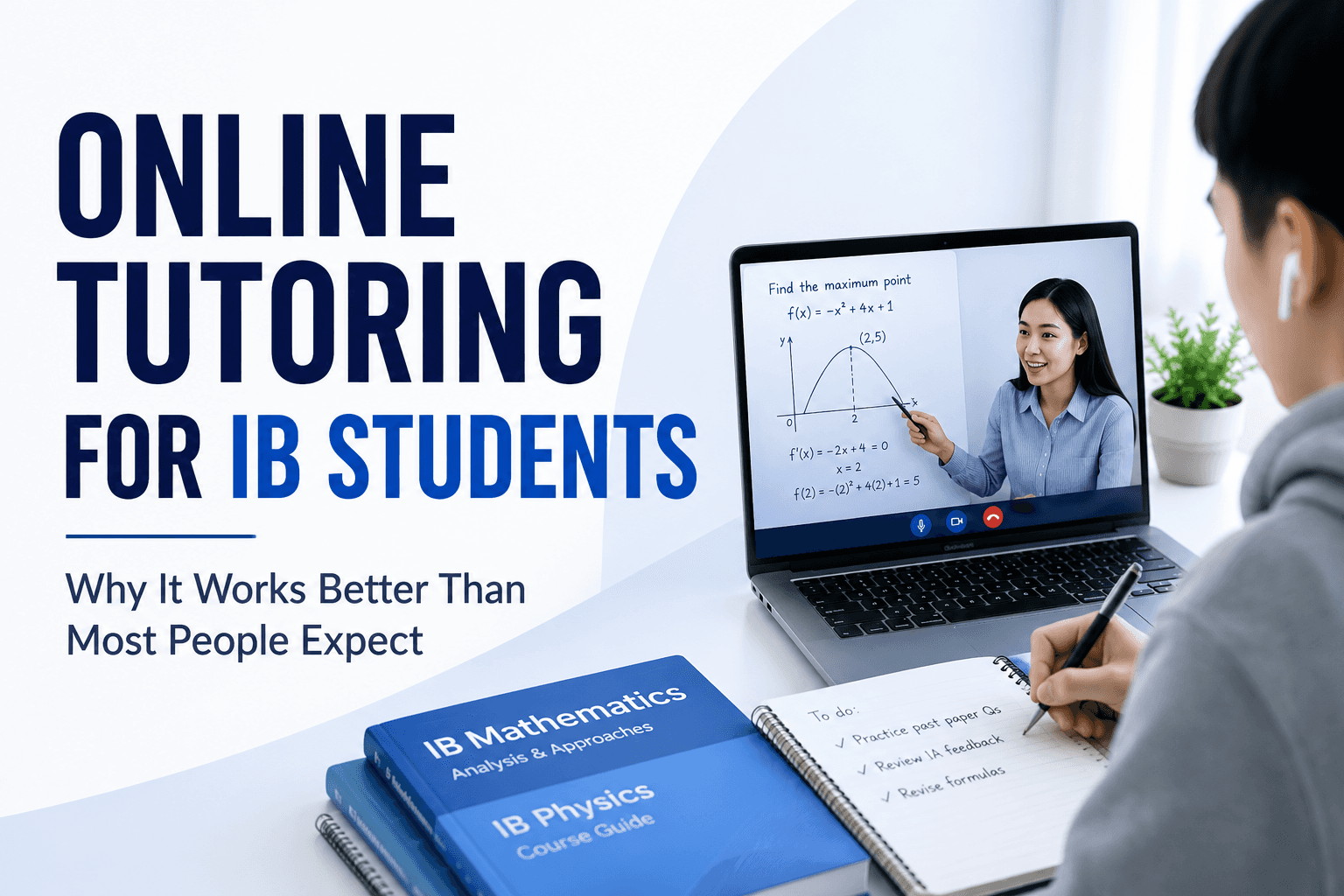
For many students and parents, “tutoring” still brings up an image of sitting at a kitchen table with a tutor, a notebook, and maybe a small whiteboard.
Online tutoring can feel like the backup option. Something you use when in-person tutoring is not available. But for IB students, online tutoring is often not a compromise at all. In many cases, it is the better fit.
The IB Diploma Programme is demanding, highly specific, and globally taught. Students need support that understands the syllabus, assessment criteria, past paper expectations, Internal Assessments, Extended Essays, and the pressure of managing multiple deadlines at once.
That is where online tutoring can work especially well. This guide explains why online tutoring is effective for IB students, what a good online session should look like, and how to choose the right IB tutor.
Why Online Tutoring Works Well for IB Students
The IB is not just academically challenging. It is also logistically challenging.
Students are balancing six subjects, Theory of Knowledge, the Extended Essay, CAS, Internal Assessments, regular school deadlines, and exam revision. For many students, the issue is not only understanding the content. It is finding enough time and energy to stay consistent.
Online tutoring helps because it removes a lot of unnecessary friction.
Instead of spending time travelling to a tutor, students can start a focused session from home. Instead of being limited to tutors nearby, they can work with someone who actually understands their IB subject, level, and assessment requirements.
For IB students, that matters. A local tutor may be good at Math, Chemistry, or English, but that does not automatically mean they understand the IB. A strong IB tutor needs to know how the subject is assessed, what examiners reward, how mark schemes work, and where students commonly lose marks.
For IB students, the best tutor is not always the closest tutor. It is the tutor who understands the IB system. Online tutoring makes it easier to find that kind of specialist.
This is especially useful for:
IB Math AA or AI at HL
IB Sciences with data analysis and IA support
IB Economics diagrams and evaluation
IB English analysis and essay structure
Extended Essay research questions and drafts
Internal Assessment planning and feedback
The more specific the IB challenge, the more important specialist support becomes.
For example, a general English tutor may help with grammar, but an IB English tutor should help the student analyze authorial choices, structure Paper 1 responses, and connect techniques to meaning.
A general Math tutor may explain calculus, but an IB Math tutor should also understand calculator use, mark scheme logic, and how to communicate mathematical reasoning clearly. That difference can affect the final grade.
Flexibility Helps IB Students Stay Consistent
IB students rarely have simple schedules.
Between school, homework, extracurricular activities, university preparation, CAS, and deadlines, it can be difficult to commit to tutoring that requires travel.
Online tutoring makes the schedule more realistic. A student can take a session after school without commuting. A tutor can adjust more easily around exam periods. Sessions can be scheduled across time zones. If a student needs help with a specific past paper question before a test, it is much easier to arrange a focused online session than to organize an in-person meeting.
This flexibility does not just make tutoring more convenient. It makes tutoring more consistent. And consistency is where results come from.
A single tutoring session can help a student understand one topic. But regular, focused support helps students build stronger habits, correct repeated mistakes, and improve over time.
If IB workload is already becoming difficult to manage, you may also find our guide on how to manage IB workload without burning out useful.
What a Good Online IB Tutoring Session Looks Like
Not all online tutoring is effective.
A weak online session looks like this:
The tutor talks through slides while the student listens passively.
That is not tutoring. That is basically a private lecture. A strong online IB tutoring session should be active. The student should be thinking, writing, explaining, solving, and receiving targeted feedback.
A good session usually includes:
Element | What It Looks Like |
|---|---|
Clear objective | The session focuses on a specific topic, question type, draft, or skill |
Active student work | The student attempts questions, explains reasoning, or revises writing in real time |
Immediate feedback | The tutor identifies exactly where the student’s thinking or method breaks down |
IB-specific guidance | The tutor connects advice to mark schemes, criteria, syllabus expectations, or examiner logic |
Follow-up task | The student leaves with clear practice or revision work before the next session |
The best tutors do not just explain the answer. They make the student’s thinking visible.
For example, in an IB Math session, the tutor should not simply solve the problem while the student watches. The student should attempt the question, explain each step, and receive correction on method, notation, calculator use, or interpretation.
In an IB English session, the tutor should not simply tell the student what a passage means. The student should practice identifying techniques, explaining effects, and building analytical paragraphs.
In an IB Economics session, the tutor should not only explain the diagram. The student should practice drawing, labelling, applying, and evaluating it in context.
Online tools can make this process smoother. Shared documents, digital whiteboards, screen sharing, and real-time annotation make it easy to work directly on the student’s actual questions, essays, IA drafts, or past papers.
Online Tutoring vs In-Person Tutoring
Online tutoring and in-person tutoring can both work. The better choice depends on the student, tutor, and situation.
But for many IB students, online tutoring has clear advantages.
Factor | Online Tutoring | In-Person Tutoring |
|---|---|---|
Tutor options | Access to IB specialists worldwide | Limited to local tutors |
Scheduling | More flexible and easier to adjust | More affected by travel and location |
Materials | Easy to use PDFs, past papers, shared docs, IA drafts, and digital whiteboards | Good for paper-based work, but less flexible digitally |
Travel time | None | Can be significant |
Best for | IB students needing specialist support and efficient scheduling | Students who need strong physical routine or younger learners |
The main advantage of in-person tutoring is structure. Some students focus better when someone is physically present. Younger students may also find in-person sessions easier.
But for most IB students, especially students who are already comfortable using laptops and digital school platforms, online tutoring can be just as effective, and often more efficient.
Common Myths About Online Tutoring
Myth 1: “You cannot build a real relationship online.”
A good tutor builds trust by understanding how the student thinks.
That does not require being in the same room. It requires careful listening, diagnostic questioning, and consistent feedback.
Many students also find it easier to ask questions online because the one-on-one environment feels less intimidating than a classroom.
Myth 2: “Online tutoring does not work for difficult subjects.”
IB Math, Physics, Chemistry, Biology, Economics, and English can all be taught effectively online when the tutor uses the right tools and keeps the session active.
For example:
Subject | What Online Tutoring Can Support |
|---|---|
Math | Solving problems on a shared whiteboard, correcting notation, reviewing calculator use |
Sciences | Working through data analysis, exam questions, IA evaluation, and methodology |
Economics | Drawing diagrams, applying theory to real-world examples, improving evaluation |
English | Editing analytical paragraphs, improving technique-effect-meaning analysis |
IA / EE | Reviewing structure, research questions, criteria, and clarity of argument |
The key is not the subject. The key is whether the session is interactive.
Myth 3: “Screen time makes students less focused.”
This concern is understandable, but online tutoring is not the same as passive screen time.
A focused tutoring session requires the student to think, answer, solve, write, and explain. That is very different from scrolling social media or watching videos.
A well-run online session is active learning through a screen, not passive consumption.
Myth 4: “Online tutors are less qualified.”
A tutor’s quality has nothing to do with whether the lesson happens online or in person.
The important questions are:
Does the tutor understand the IB?
Have they taught this subject and level before?
Can they explain the mark scheme or assessment criteria?
Can they identify the student’s specific weaknesses?
Can they give feedback that leads to improvement?
For IB students, subject-specific experience matters much more than location.
How to Choose the Right Online IB Tutor
Choosing the right tutor is the most important part of online tutoring.
For IB subjects, do not look only for someone who is “good at the subject.” Look for someone who understands the IB system.
A strong IB tutor should be able to help with:
Syllabus content
Exam-style questions
Mark scheme expectations
Assessment criteria
IA or EE planning where appropriate
Subject-specific writing or problem-solving skills
Revision strategy before exams
Before choosing a tutor, ask:
Question | Why It Matters |
|---|---|
Have you taught IB students before? | IB assessment is specific and different from many national systems |
Do you know this subject and level? | HL and SL expectations can be very different |
Can you help with past paper technique? | IB exams require mark scheme awareness |
Can you give feedback on IA or coursework structure? | Coursework often requires criteria-based feedback |
How do you run online sessions? | A good session should be active, not lecture-based |
A tutor who understands the IB can save students a lot of time because they know what matters and what does not.
For students working on coursework, our IB Internal Assessment guide and IB Extended Essay guide also explain how criteria-based writing affects final marks.
How to Get the Most Out of Online Tutoring
Even a strong tutor cannot help much if the student comes unprepared.
The best online tutoring results usually come from students who bring specific problems to each session.
Instead of saying:
I do not understand Chemistry.
A stronger starting point is:
I can solve the equilibrium calculation, but I do not understand when to use the ICE table or how to interpret the final answer.
Instead of saying:
I need help with English.
A stronger starting point is:
My teacher says my analysis is too descriptive. Can we work on how to explain the effect of techniques in Paper 1?
Specific questions lead to specific improvement.
Students should try to bring:
a past paper question they got wrong
a test or quiz they want to review
an IA or EE section they are struggling with
a paragraph they want feedback on
a topic list before an upcoming exam
a mark scheme they do not understand
After the session, students should also complete follow-up work. Tutoring gives direction, but improvement comes from practice.
Thirty minutes of focused practice after each session can make a major difference over time.
When Online Tutoring May Not Be the Best Fit
Online tutoring works well for many IB students, but it is not perfect for everyone.
It may be less suitable if a student is very young, struggles to focus on video calls, needs strong physical supervision to stay on task, has no quiet place to study, or does not have stable internet.
In those cases, in-person tutoring or a stronger home study structure may be better.
But for many IB students, especially motivated students who need specialist academic support, online tutoring is often one of the most effective options available.
Need Online Tutoring for IB?
Online tutoring is not just a convenient alternative to in-person tutoring. For IB students, it can provide access to better specialists, more flexible scheduling, and more targeted support.
The most important thing is choosing a tutor who understands the IB system and can help the student improve in the specific areas that affect marks.
At LightHouse Global, we support IB students through one-on-one online tutoring across subjects, including IB Math, Sciences, Economics, English, Internal Assessments, Extended Essays, and exam preparation.
Our goal is not just to explain content. It is to help students understand what the IB is asking for and how to improve their performance strategically.
Learn more here:
https://lhtutor.com/programs-ib-support
FAQ: Online Tutoring for IB Students
Is online tutoring effective for IB students?
Yes. Online tutoring can be highly effective for IB students when sessions are active, structured, and taught by tutors who understand the IB syllabus and assessment criteria.
Is online tutoring better than in-person tutoring?
It depends on the student. Online tutoring often provides better access to IB specialists and more flexible scheduling, while in-person tutoring may help students who need a stronger physical routine.
What should I look for in an online IB tutor?
Look for a tutor with direct IB experience in the relevant subject and level. They should understand the syllabus, exam expectations, mark schemes, and coursework criteria.
Can online tutoring help with IB Internal Assessments?
Yes. A tutor can help students understand the IA criteria, refine their topic, improve structure, and identify weaknesses in analysis or evaluation. The final work must still remain the student’s own.
Can online tutoring help with the Extended Essay?
Yes. Online tutors can help students refine their research question, plan their structure, understand academic expectations, and improve clarity and argumentation in their draft.
How often should an IB student have online tutoring?
Many students benefit from one weekly session per subject, but this depends on the student’s goals, deadline pressure, and current level. Before exams or major coursework deadlines, short-term intensive support may also be useful.